

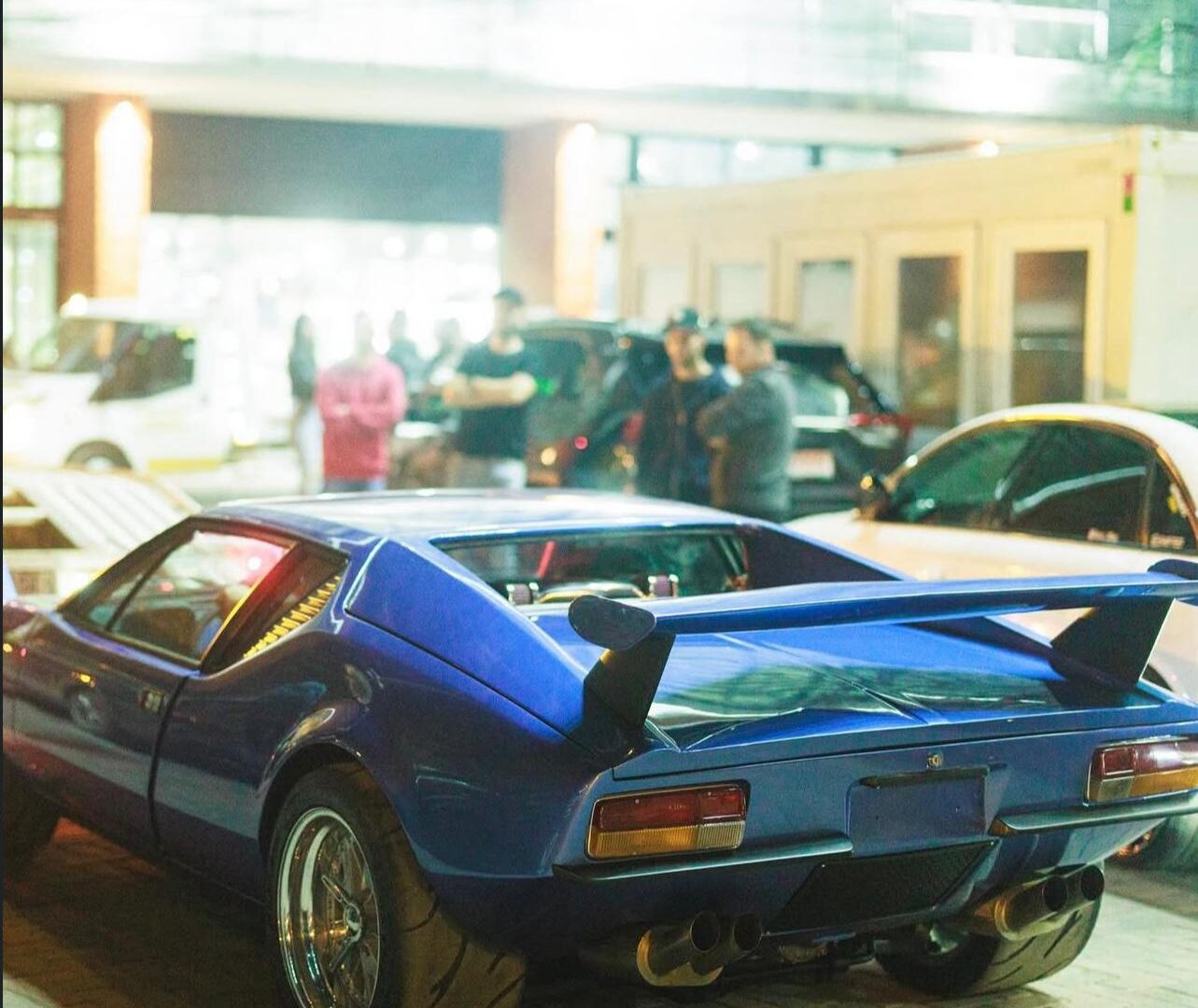
Tom Tjaarda at Ghia, a Ford Cleveland in the middle, ZF gearbox: the Italo-American recipe that made the Pantera a 1970s supercar.
In Modena in 1959, Alejandro de Tomaso began with competition prototypes and Formula 1 dreams. A decade later, the recipe that made his name on the road was not an Italian V12 but a transatlantic bargain: a body drawn by Tom Tjaarda at Carrozzeria Ghia, a Ford Cleveland V8 mounted amidships, American distribution through the Ford partnership.
The 1973 Pantera in the collection is that recipe in its most readable form. The wedge silhouette, muscular rear haunches, hidden headlamps and Campagnolo wheels belong to a GT you recognise before you read the lettering. It is exotic without being fragile. It is Italian without refusing American torque.
351 cubic inches, ZF gearbox, 1,420 kg
The engine is a Ford Cleveland 351 ci, about 5.8 litres, rated in early spec at 330 hp at 5,400 rpm and 466 Nm at 3,500 rpm. A five-speed ZF gearbox and rear-wheel drive put all of that torque to work. Period figures — 0–100 km/h in 5.8 seconds, 256 km/h, 1,420 kg — placed it, in the press, alongside Ferrari, Maserati, Lamborghini or Porsche, not as an Italo-American curiosity but as a rival.
The low centre of gravity and the mass distribution make the dropped cabin a workplace, not a lounge. Instruments are clear, seats are sporting, finishes — leather and inserts, depending on the series — remain those of a 1970s GT: functional, without the contemporary theatre of screens. Air conditioning and electric windows, where fitted, do not contradict the character. They make it usable.
A panther of popular culture, not only of catalogues
Built in successive series into the 1990s, including the Lusso, the Pantera outlived the fashion of one early-decade motor show. It appeared in celebrity garages and in the imagination of a generation that wanted Italian design with American serviceability. That was its strength and, sometimes, its prejudice: too Ford for purists, too Ghia for Detroit.
Seen today, the argument is secondary. What remains is Tjaarda’s drawing and the way a familiar V8 sits behind the shoulders. In the collection, 1973 is the year the bargain reads cleanest: before later refinements softened the silhouette, after the recipe was already understood. American V8, Italian body — a short sentence, like a burst of acceleration.